
Anger is a force that builds, surges, and sometimes explodes, and capturing that energy in writing takes more than simply saying someone was “angry.” A simile is a figure of speech that compares two unlike things using “like” or “as,” helping writers turn a raw emotion into something readers can practically feel building beneath the surface. Similes matter in figurative language because they translate internal intensity—like the pressure and heat of rage—into external images the reader instantly recognizes.
When a writer compares fury to “a geyser building toward release,” the reader doesn’t just understand anger, they sense the tension right before it erupts. Nature similes are especially effective here, since forces like storms, wildfires, and wild animals already embody that same unpredictable, forceful energy that anger carries. In the same way that trees are often used to symbolize strength, growth, resilience, wisdom, and human emotion, untamed natural forces are used to symbolize the raw, uncontrollable power of anger.
Great similes in literature use this kind of charged imagery to make emotional scenes feel immediate, physical, and impossible to ignore. In this article, you’ll discover 15 powerful angry similes, complete with meanings, usage insights, and example sentences to elevate your own writing.
What Is a Simile?
A simile is a comparison between two different things, usually joined by “like” or “as,” used to make writing more vivid and expressive. Instead of simply stating a fact, a simile helps the reader visualize or emotionally connect with an idea. For example, saying “he was angry as a geyser building toward release” instantly creates a sense of mounting pressure and inevitable eruption, far more powerful than simply saying “he was very angry.”
Angry as a Wounded Bear Defending Its Den
Meaning:
This simile compares anger to the fierce, protective aggression of an injured bear guarding what it values most, suggesting fury driven by threat or vulnerability.
Usage Insight:
It works best when describing anger tied to protecting someone or something important, especially in defensive confrontations.
Example Sentences:
- She turned angry as a wounded bear defending its den the moment she heard someone criticize her daughter.
- He grew angry as a wounded bear defending its den, refusing to let anyone question his team’s integrity.
Angry as a Pressure Cooker Whistling with Steam
Meaning:
This simile compares anger to built-up internal pressure finally finding release, suggesting frustration that has been contained for too long.
Usage Insight:
It’s ideal for describing anger that has been suppressed and is now demanding to be expressed.
Example Sentences:
- After weeks of biting her tongue, she was angry as a pressure cooker whistling with steam by the time the meeting started.
- His temper had grown angry as a pressure cooker whistling with steam, ready to burst at the smallest provocation.
Angry as a Swarm of Bees Defending Their Hive
Meaning:
This simile compares anger to the coordinated, aggressive response of bees protecting their colony, suggesting collective fury directed at a single threat.
Usage Insight:
It works well when describing group anger or a shared reaction to a perceived injustice.
Example Sentences:
- The neighborhood grew angry as a swarm of bees defending their hive when the new development plans were announced.
- Fans turned angry as a swarm of bees defending their hive after the referee’s controversial call.
Angry as an Ocean Churned by an Unseen Storm
Meaning:
This simile compares anger to the turbulent, unpredictable motion of the sea during a storm, suggesting deep, powerful emotion stirred from beneath the surface.
Usage Insight:
It’s effective in dramatic or introspective writing, particularly when describing anger that feels overwhelming or difficult to control.
Example Sentences:
- Her emotions were angry as an ocean churned by an unseen storm, though her expression stayed perfectly calm.
- He felt angry as an ocean churned by an unseen storm, the resentment rising faster than he could manage.
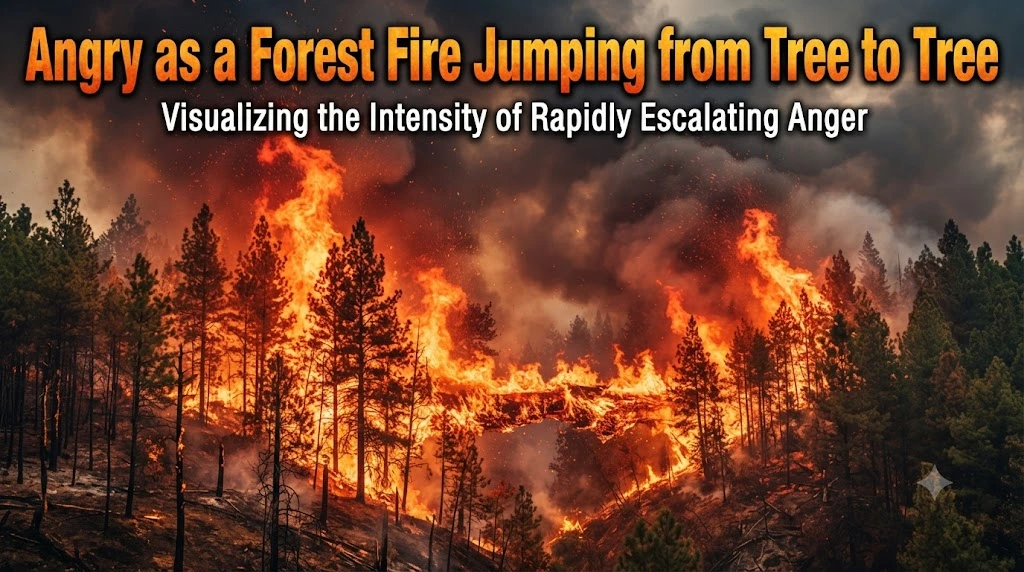
Angry as a Forest Fire Jumping from Tree to Tree
Meaning:
This simile compares anger to a fire spreading rapidly and unpredictably, suggesting an emotional reaction that intensifies and expands quickly.
Usage Insight:
It works well when describing anger that escalates fast, especially in arguments that spiral out of control.
Example Sentences:
- The debate turned angry as a forest fire jumping from tree to tree, with accusations flying from every direction.
- His frustration became angry as a forest fire jumping from tree to tree, consuming every calm thought he’d had moments earlier.
Angry as a Bull Elephant Charging Through the Brush
Meaning:
This simile compares anger to the overwhelming, unstoppable force of a massive animal in motion, suggesting intensity that can’t be reasoned with in the moment.
Usage Insight:
It’s ideal for describing anger that feels physically overpowering or difficult to interrupt once it begins.
Example Sentences:
- He stormed into the office angry as a bull elephant charging through the brush, demanding answers immediately.
- She felt angry as a bull elephant charging through the brush, unable to slow down long enough to think clearly.
Angry as a Geyser Building Toward Release
Meaning:
This simile compares anger to underground pressure that builds steadily until it erupts with force, suggesting inevitability and mounting tension.
Usage Insight:
It works well for slow-building anger that reaches a breaking point after prolonged frustration.
Example Sentences:
- Months of unresolved conflict left her angry as a geyser building toward release, and the argument finally erupted at dinner.
- His resentment grew angry as a geyser building toward release, impossible to hold back any longer.
Angry as Static Crackling Before a Lightning Strike
Meaning:
This simile compares anger to the tense, electric feeling in the air right before something explosive happens, suggesting anticipation and unspoken tension.
Usage Insight:
It’s effective for foreshadowing conflict, particularly in scenes where anger is building but hasn’t yet been expressed aloud.
Example Sentences:
- The room felt angry as static crackling before a lightning strike, everyone sensing the confrontation about to unfold.
- His silence was angry as static crackling before a lightning strike, more unsettling than any raised voice.
Angry as a Scorpion Cornered with Nowhere to Run
Meaning:
This simile compares anger to a defensive, dangerous reaction from someone who feels trapped, suggesting fear-driven aggression.
Usage Insight:
It works well when describing anger that emerges from feeling threatened, cornered, or out of options.
Example Sentences:
- She lashed out angry as a scorpion cornered with nowhere to run when accused of something she hadn’t done.
- He became angry as a scorpion cornered with nowhere to run once he realized there was no way to fix his mistake.
Angry as an Avalanche Gathering Speed Downhill
Meaning:
This simile compares anger to an unstoppable force that grows larger and more destructive as it progresses, suggesting escalation beyond control.
Usage Insight:
It’s ideal for describing anger that spirals quickly out of proportion once it begins.
Example Sentences:
- The argument became angry as an avalanche gathering speed downhill, impossible to stop once it started rolling.
- His temper turned angry as an avalanche gathering speed downhill, each word adding more force to the outburst.
Angry as a Tiger Pacing Behind Iron Bars
Meaning:
This simile compares anger to restrained, contained aggression that has no immediate outlet, suggesting frustration mixed with helplessness.
Usage Insight:
It works well when describing anger a character is forced to control despite wanting to react.
Example Sentences:
- He sat through the meeting angry as a tiger pacing behind iron bars, holding back every word he wanted to say.
- She stayed silent, angry as a tiger pacing behind iron bars, waiting for the right moment to respond.
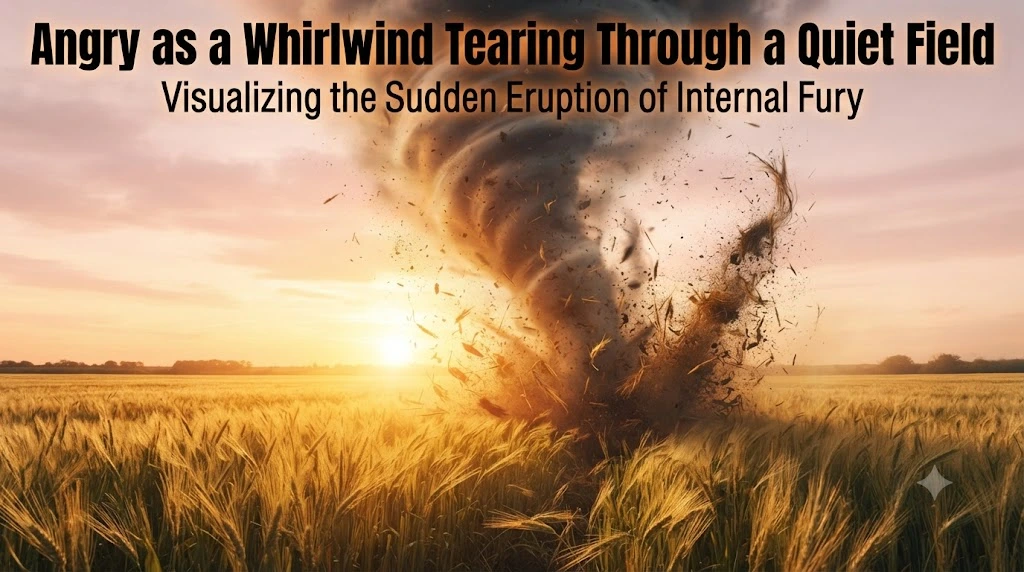
Angry as a Whirlwind Tearing Through a Quiet Field
Meaning:
This simile compares anger to a sudden, forceful disturbance that disrupts calm surroundings, suggesting unexpected intensity.
Usage Insight:
It’s effective for describing anger that erupts suddenly in an otherwise peaceful setting or relationship.
Example Sentences:
- His reaction was angry as a whirlwind tearing through a quiet field, catching everyone completely off guard.
- The calm dinner turned angry as a whirlwind tearing through a quiet field the moment the topic was raised.
Angry as a Blacksmith’s Hammer Striking Hot Iron
Meaning:
This simile compares anger to forceful, repeated impact, suggesting intensity shaped by repetition and pressure.
Usage Insight:
It works well when describing anger expressed through repeated confrontation or persistent frustration.
Example Sentences:
- He responded angry as a blacksmith’s hammer striking hot iron, each point landing harder than the last.
- Her criticism grew angry as a blacksmith’s hammer striking hot iron, relentless and impossible to ignore.
Angry as a Wolf Baring Its Teeth at an Intruder
Meaning:
This simile compares anger to an instinctive, protective warning, suggesting aggression meant to establish boundaries or defend territory.
Usage Insight:
It’s ideal for describing anger triggered by a perceived violation of trust or personal space.
Example Sentences:
- She turned angry as a wolf baring its teeth at an intruder when she discovered the betrayal.
- He became angry as a wolf baring its teeth at an intruder the instant his loyalty was questioned.
Angry as a Firecracker Lit with a Short Fuse
Meaning:
This simile compares anger to a quick, sudden explosion with very little warning, suggesting a short temper and immediate reaction.
Usage Insight:
It works well when describing characters known for reacting quickly and intensely to minor provocations.
Example Sentences:
- He was angry as a firecracker lit with a short fuse, reacting before anyone could finish explaining.
- Her temper was angry as a firecracker lit with a short fuse, and the smallest comment could set her off.
How to Use Similes Effectively in Writing
Similes can transform flat description into vivid imagery, but only when used with intention. Here are some practical tips for using angry similes—and similes in general—across different types of writing:
- poems: Choose similes that match the poem’s emotional tone. A poem about buried resentment calls for “angry as a pressure cooker whistling with steam,” while a poem about sudden rage might use “angry as a firecracker lit with a short fuse.”
- In stories: Use similes to reveal a character’s emotional state without stating it directly. Instead of writing “he was furious,” show it through “he sat angry as a tiger pacing behind iron bars.”
- essays: Use similes sparingly and purposefully to add stylistic depth when describing emotional conflict, especially in narrative or reflective writing.
- In songs: Choose short, rhythmic similes that flow naturally when sung aloud, since lyrical similes need to sound as good as they read.
- creative descriptions: Match the simile to the pace of the anger—use slow-building similes for simmering frustration, and sudden, explosive similes for quick outbursts.
- General rule: Avoid overusing similes in a single paragraph. One well-placed comparison is often more powerful than several stacked together.
FAQs About Powerful Angry Similes
1. What are some powerful angry similes for writing?
Some powerful angry similes include “angry as a geyser building toward release,” “angry as an avalanche gathering speed downhill,” and “angry as a wolf baring its teeth at an intruder.” Each one captures a different intensity and pace of anger, from slow-building pressure to sudden aggression.
2. What is the difference between a simile and a metaphor?
A simile compares two things using “like” or “as” (e.g., “angry as a forest fire jumping from tree to tree”), while a metaphor states that one thing is another without using comparison words (e.g., “his anger was a forest fire”). Similes are generally softer and more descriptive, while metaphors are more direct and symbolic.
3. Why are nature similes so effective for describing anger?
Nature similes work well because forces like storms, wildfires, and animal instincts already carry unpredictable, powerful energy, making them ideal for representing the intensity and danger of human anger in a way readers can visualize.
4. Can similes be used in academic writing?
Yes, similes can be used in academic writing, particularly in reflective, narrative, or descriptive writing about emotion or conflict, but they should be used sparingly and appropriately to maintain a professional tone.
5. How do similes improve creative writing?
Similes improve creative writing by turning abstract emotions into vivid, sensory images, helping readers feel a character’s anger rather than simply reading about it.
Conclusion
Anger is rarely simple—it can build slowly, erupt suddenly, or simmer quietly beneath a calm surface, and capturing that complexity takes more than plain description. Powerful angry similes give writers a way to bring that raw emotion to life, whether it’s the mounting pressure of a geyser or the sudden spark of a lit firecracker. By comparing anger to forces of nature, wild animals, and physical tension, these similes add clarity, imagery, and emotional depth that plain language simply can’t achieve. Whether you’re writing poetry, fiction, essays, or song lyrics, choosing the right simile can turn a simple emotional beat into a moment readers truly feel. The next time you need to describe anger in your writing, reach for one of these comparisons and let your words carry all the heat and force that real rage deserves.