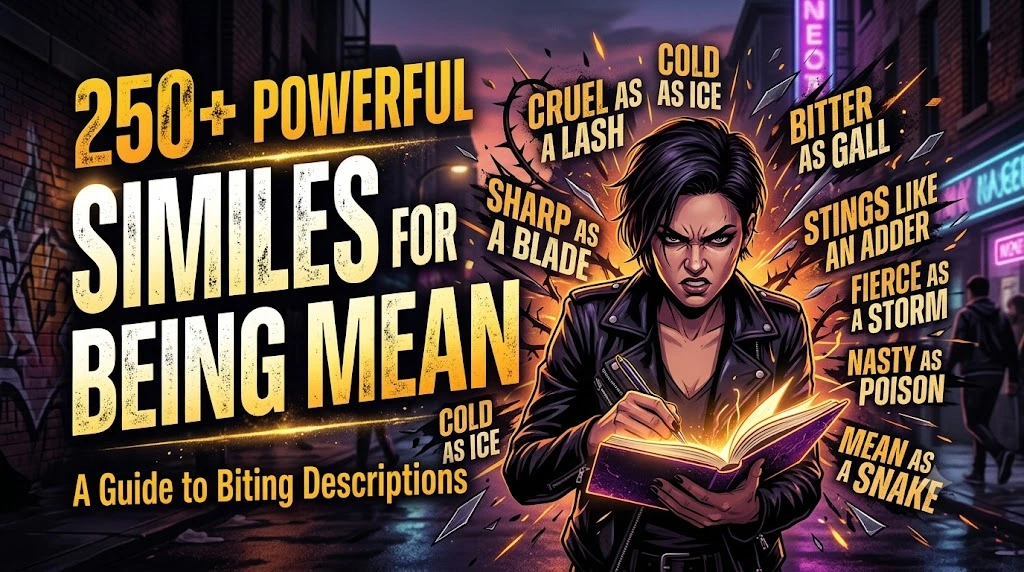
Cruelty is one of those emotions and behaviors that flat description simply cannot capture, but a well-crafted simile can make a reader feel its sting instantly. When you write that a character is “mean,” you offer a label. When you write that their words “cut like a blade dragged across skin,” you offer an experience the reader can’t shake off. This is the real power of a simile: it takes an abstract quality, like cruelty, and turns it into something the reader can see, hear, and feel in their bones.
A simile works by comparing two unrelated things using “like” or “as,” borrowing the vividness of one image to sharpen the meaning of another, and this small trick is one of the most effective tools in figurative language. Nature has always offered some of the richest material for these comparisons, because the natural world is full of images that are both beautiful and merciless — thorns, storms, predators, and frost all carry a harshness that mirrors human cruelty perfectly. That’s why nature similes appear so often in literature exploring meanness, jealousy, and cold-heartedness; they let writers borrow the danger of the wild to describe the danger in people.
Poets, novelists, and songwriters reach for these comparisons again and again because they turn a simple character trait into a memory that lingers with the reader. In this guide, you’ll find fifteen original, ready-to-use similes for being mean, each explained with its meaning, its ideal use in writing, and two polished example sentences to help you sharpen your own storytelling.
What Is a Simile?
A simile is a figure of speech that compares two different things using the words “like” or “as,” drawing attention to a shared quality between them to build a vivid, memorable image.
For example:
saying “his laughter was as cold as a slammed door” doesn’t just tell us he was unkind — it lets us hear and feel the harshness of that moment, transforming a plain statement into striking imagery.
1. Mean as a Thorn Hidden in a Rose
Meaning:
This simile describes cruelty disguised as charm, where someone appears pleasant on the surface but hides a sharp, hurtful nature underneath.
Usage Insight:
It works best when introducing a character whose true personality is revealed slowly, especially in stories where first impressions turn out to be deceptive.
Example Sentences:
- Everyone adored her at first, not realizing she was mean as a thorn hidden in a rose.
- His compliments always carried a sting, mean as a thorn hidden in a rose, leaving people unsure whether to feel flattered or hurt.
2. Cutting Words Like a Blade Through Silk
Meaning:
This comparison captures how effortlessly and sharply cruel words can wound someone, slicing through confidence the way a blade slices through delicate fabric.
Usage Insight:
Use this simile during confrontations or arguments where dialogue needs to land with real emotional force, particularly in scenes meant to shock the reader.
Example Sentences:
- Her cutting words sliced like a blade through silk, and he didn’t speak again for the rest of the meeting.
- The critic’s review went through the young author’s confidence like a blade through silk, precise and merciless.
3. Cold as Frost on a Winter Morning
Meaning:
This simile describes a person’s harsh, unfeeling demeanor, comparing their emotional distance and cruelty to the biting chill of frost.
Usage Insight:
This works especially well for describing a character’s tone or expression rather than a single action, making it useful in introductions or character descriptions.
Example Sentences:
- The manager’s response was cold as frost on a winter morning, leaving no room for questions or excuses.
- She stared at him, cold as frost on a winter morning, and walked away without another word.
4. Stinging Like a Wasp Defending Its Nest
Meaning:
This simile portrays sudden, sharp cruelty that emerges when a person feels threatened or provoked, striking quickly and painfully.
Usage Insight:
Ideal for moments of conflict or confrontation where a character’s meanness is reactive rather than constant, this simile adds urgency and a sense of danger.
Example Sentences:
- The moment someone questioned her decision, she snapped back, stinging like a wasp defending its nest.
- He lashed out at the smallest criticism, stinging like a wasp defending its nest, and the room fell silent.
5. Sharp as Broken Glass on a Sidewalk

Meaning:
This comparison highlights the danger hidden in ordinary interactions with a mean person, much like broken glass blending unnoticed into a familiar path.
Usage Insight:
This simile works well for building tension in everyday settings, showing how cruelty can appear where least expected, such as in casual conversation or friendly gatherings.
Example Sentences:
- Her jokes were sharp as broken glass on a sidewalk, funny to everyone except the person they targeted.
- Beneath his easy smile, his opinions were sharp as broken glass on a sidewalk, ready to wound anyone who stepped too close.
6. Cruel as a Storm That Shows No Mercy
Meaning:
This nature-inspired simile emphasizes overwhelming, relentless cruelty, comparing a person’s harsh behavior to a storm that destroys without hesitation or remorse.
Usage Insight:
Best used for describing a character at their most intense or villainous moment, this simile works well in climactic scenes where the full extent of someone’s cruelty is finally revealed.
Example Sentences:
- Once he took control of the company, he ruled it cruel as a storm that shows no mercy.
- Her temper struck the household cruel as a storm that shows no mercy, leaving everyone bracing for the next outburst.
7. Harsh as Gravel Beneath Bare Feet
Meaning:
This simile describes words or actions that are uncomfortable and painful, comparing their impact to the rough, jagged feeling of walking barefoot over gravel.
Usage Insight:
This works well for describing ongoing mistreatment rather than a single sharp moment, making it useful in narration that spans a longer relationship or history between characters.
Example Sentences:
- Living under her criticism felt harsh as gravel beneath bare feet, day after day, with no relief in sight.
- His feedback was harsh as gravel beneath bare feet, technically accurate but delivered without any kindness.
8. Venomous as a Snake Coiled in the Grass
Meaning:
This simile describes hidden cruelty and danger, portraying a person as deceptively calm on the surface while ready to strike with harmful intent.
Usage Insight:
Use this simile for antagonists or manipulative characters whose true nature is concealed until a pivotal moment, adding suspense and unease to their presence.
Example Sentences:
- He seemed friendly enough in meetings, but everyone in the office knew he was venomous as a snake coiled in the grass.
- Her smile never wavered, venomous as a snake coiled in the grass, even as she plotted her rival’s downfall.
9. Bitter as Unripe Fruit
Meaning:
This comparison captures a sourness of character, describing someone whose cruelty stems from resentment, jealousy, or unresolved anger.
Usage Insight:
This simile is effective for characters whose meanness comes from a deeper emotional wound rather than pure malice, adding nuance and backstory potential to their personality.
Example Sentences:
- Years of being overlooked left him bitter as unripe fruit, quick to criticize anyone who succeeded where he hadn’t.
- Her remarks about her sister’s wedding were bitter as unripe fruit, tinged with envy she refused to admit.
10. Relentless as a Predator Stalking Its Prey
Meaning:
This simile portrays calculated, persistent cruelty, comparing a person’s behavior to the patient, deliberate hunting instinct of a predator.
Usage Insight:
Best suited for describing bullying, manipulation, or long-term psychological cruelty, this simile works well in tense narrative buildups where the reader senses danger before it fully arrives.
Example Sentences:
- The rumors followed her all semester, relentless as a predator stalking its prey, until she dreaded walking into class.
- He pursued his rival’s downfall relentless as a predator stalking its prey, patient and utterly without pity.
11. Merciless as a Blizzard Burying Everything in Its Path
Meaning:
This simile emphasizes overwhelming and indiscriminate cruelty, comparing a person’s harshness to a blizzard that spares nothing and no one.
Usage Insight:
This works best in scenes of widespread conflict or when a character’s cruelty affects many people at once, such as a tyrant, boss, or authority figure.
Example Sentences:
- The new policy swept through the department merciless as a blizzard burying everything in its path.
- His criticism during the review was merciless as a blizzard burying everything in its path, sparing no one’s effort or pride.
12. Prickly as a Cactus in the Desert Heat

Meaning:
This simile describes a defensive, irritable form of meanness, where a person’s sharp responses seem to protect them from vulnerability or closeness.
Usage Insight:
Use this simile for characters who are difficult but not entirely villainous, since it suggests self-protection rather than pure cruelty, making it useful for morally complex personalities.
Example Sentences:
- Her coworkers learned to approach her carefully, prickly as a cactus in the desert heat, especially early in the morning.
- He was prickly as a cactus in the desert heat with anyone who tried to get too close, pushing away even those who cared about him.
13. Ruthless as a Wildfire Consuming Dry Brush
Meaning:
This comparison highlights fast, destructive cruelty that spreads without hesitation, much like a wildfire consuming everything flammable in its way.
Usage Insight:
This simile is ideal for depicting sudden betrayals or aggressive takeovers, particularly in workplace, political, or family power struggles where damage happens quickly and publicly.
Example Sentences:
- Once he sensed weakness in his opponent’s campaign, he attacked ruthless as a wildfire consuming dry brush.
- Her ambition made her ruthless as a wildfire consuming dry brush, and no friendship was safe from her rise to power.
14. Piercing as a Winter Wind Through a Thin Coat
Meaning:
This simile describes cruelty that feels inescapable and deeply personal, comparing hurtful words or actions to a biting wind that finds its way through even the smallest gaps.
Usage Insight:
Best used for emotionally intimate scenes, such as arguments between close friends or family members, this simile emphasizes how meanness feels worse when it comes from someone we trust.
Example Sentences:
- Her mother’s disappointment was piercing as a winter wind through a thin coat, impossible to ignore no matter how she tried.
- His silence after the accusation was piercing as a winter wind through a thin coat, colder than any words could have been.
15. Callous as Stone Worn Smooth by Time
Meaning:
This simile describes a hardened indifference to others’ feelings, suggesting a cruelty that has settled in over years, much like stone shaped by relentless erosion.
Usage Insight:
This works particularly well for older or long-established characters whose meanness feels ingrained rather than sudden, adding a sense of history and permanence to their personality.
Example Sentences:
- After decades of running the business alone, he had grown callous as stone worn smooth by time.
- The old headmistress was callous as stone worn smooth by time, unmoved by the students’ tears or excuses.
How to Use Similes Effectively in Writing
Similes are most powerful when they’re chosen with care rather than scattered throughout a piece for decoration. Here’s how to use them well across different types of writing:
- poems: Let one strong simile carry the emotional weight of a stanza instead of stacking several together. Match the tone of the comparison to the rhythm and mood of the poem as a whole.
- In stories: Use similes to reveal character rather than simply describe action. A cruel character’s chosen words, or the comparisons used to describe them, should reflect their personality and backstory.
- essays: Similes can make abstract ideas about behavior or human nature easier to understand, but they should remain clear and purposeful, especially in formal or analytical contexts.
- In songs: Sharp, sensory similes work beautifully in lyrics because they’re memorable and easy to sing. Choose comparisons that are vivid but simple enough to land in a single listen.
- creative descriptions: Avoid clichés when you can, and don’t hesitate to invent your own comparisons drawn from nature, weather, or everyday objects. Original similes leave a far stronger impression than familiar ones.
- General rule: Similes should deepen emotion and imagery, not replace strong storytelling. One vivid, well-placed simile will always outperform several vague ones crowded into the same paragraph.
FAQs
1. What are the best similes for being mean?
Some of the most powerful similes for being mean include “cutting words like a blade through silk,” “cold as frost on a winter morning,” and “venomous as a snake coiled in the grass.” These work well because they turn an abstract trait like cruelty into something readers can vividly picture and feel.
2. What is the difference between a simile and a metaphor?
A simile compares two things using “like” or “as,” such as “mean as a thorn hidden in a rose,” while a metaphor states that one thing directly is another, such as “she was a thorn hidden in a rose.” Both create strong imagery, but similes make the comparison more explicit and often easier for readers to follow.
3. Why are nature similes so effective for describing meanness or cruelty?
Nature similes work well for cruelty because natural forces like storms, frost, and predators are powerful, unpredictable, and often merciless, which mirrors the harshness of unkind behavior. These comparisons tap into instinctive associations most readers already carry, making the description feel immediate and real.
4. Can similes be used in academic or formal writing?
Yes, similes can be used in academic writing when they clarify a concept or make an argument more relatable, but they should be used sparingly and with precision. Overly dramatic or poetic similes are usually better suited to creative writing than formal essays or research papers.
5. How can I create my own original similes for being mean?
Begin by identifying the specific quality of cruelty you want to describe, whether it’s coldness, sharpness, or persistence, then think of an object, animal, or natural event that shares that same quality. Reading widely across literature and poetry is one of the best ways to train yourself to notice fresh, unexpected comparisons.
Conclusion
Powerful similes for being mean do more than add color to a sentence — they let readers feel cruelty the way a character experiences it, through cold silences, sharp words, and relentless behavior that lingers long after the moment passes. By drawing on vivid imagery, especially the harsh, unforgiving power of nature, these comparisons turn a simple character trait into something unforgettable.
Whether you’re crafting a tense short story, a biting poem, a personal essay, or the lyrics to a song, a well-chosen simile adds clarity, imagery, and emotional depth that plain description alone can never achieve. The fifteen similes in this guide are meant to inspire, not limit — the strongest writers keep observing the world around them and shaping new comparisons of their own. So the next time cruelty enters your writing, don’t just tell your reader that a character is mean. Show them, through frost, thorns, or a storm that shows no mercy, and let your words carry the sting.